
Bad Storytelling Kills Great Startups (and How to Fix It)
Most startups don’t lose because the product is bad.
They lose because nobody understands why it matters.
You can A/B test, rebrand, or polish the deck a hundred times, but if the narrative underneath is broken, every tactic just amplifies the disconnect that is already there.
The hard truth:
The best product doesn’t win.
The best story does.
In crowded markets, story beats features and functionality.
Investors, partners, and customers don’t have time to decode your brilliance. They need a story they can repeat in one sentence after you leave the room.
When they can’t, traction dies quietly.
The product can have the greatest potential but still doesn't connect with customers from lack of being understood, standing out, and evoking inspiration or excitement.
That’s what StoryOS exists to fix: a structured way to align what founders mean, what teams say, and what markets hear so the story works as hard as the product.
Why smart founders still miss the mark
The hardest thing to build isn’t the product.
It’s the shared understanding of what the product means.
In early growth stages, everything changes: messaging, decks, priorities, even the problem definition. Every iteration makes sense in isolation. But seen together, they create a drifting narrative.
Here’s how that drift shows up:
Polite interest, no momentum. You get “Love what you’re doing,” but no next steps.
Deck drift. Your story sounds different in every meeting.
Feature fog. You lead with what it does, not why it matters.
Category confusion. People don’t know how to place you, so they don’t.
Team misalignment. Product says X, sales says Y, and hiring says Z.
The alignment gap
In StoryOS projects, we call this the alignment gap, the distance between what founders mean, what teams say, and what markets hear.
You can’t close that gap with better copy. You close it with narrative architecture: a shared mental model of how your story works, who it serves, and how it evolves. So that your story becomes unified and clear on every touchpoint.
From messaging to meaning
Founders often think storytelling is about what to say.
But real narrative strategy starts with what to mean.
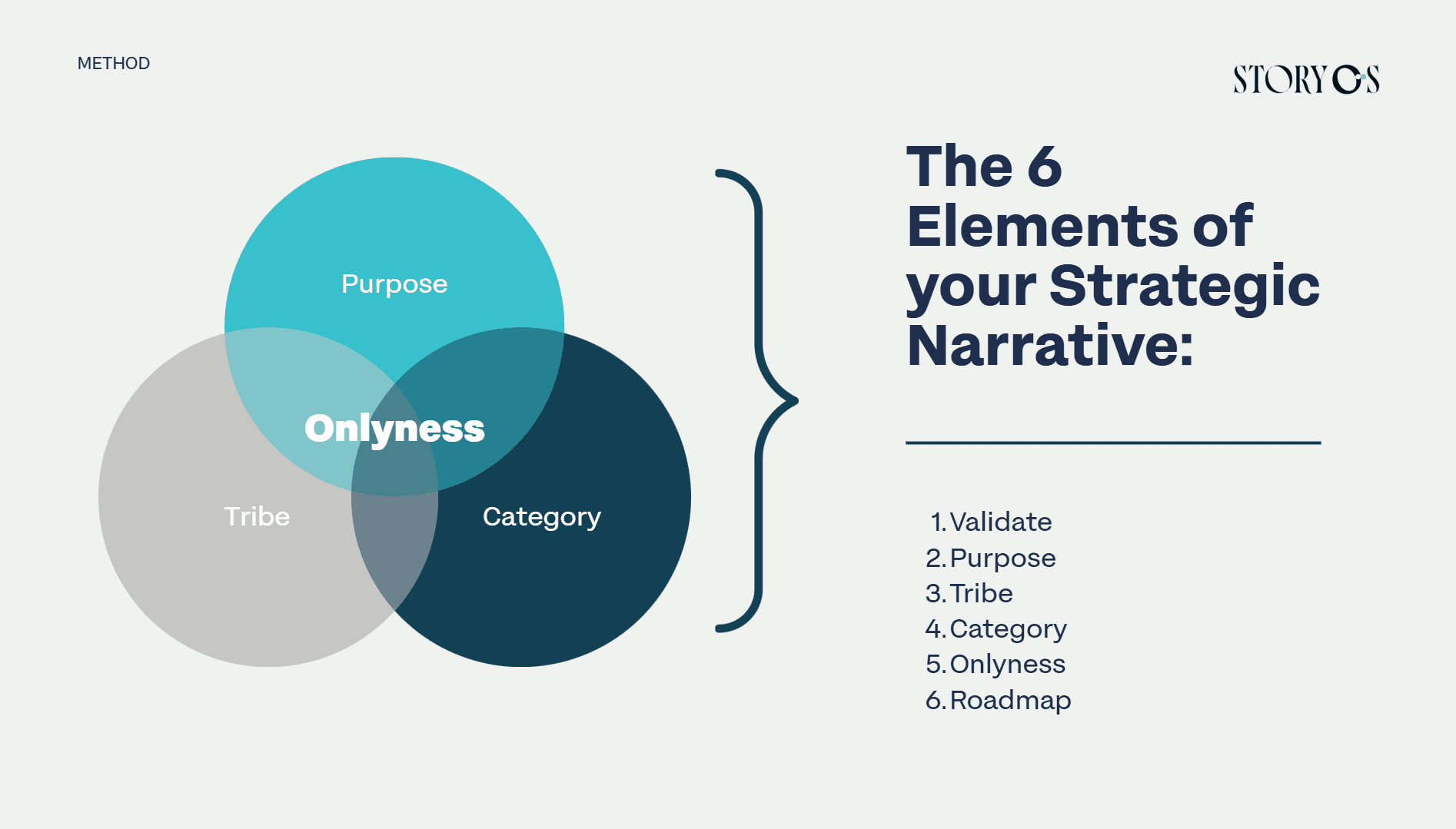
Before you rewrite your deck or website, you have to pressure-test the story beneath it:
Validate: Uncover the problem and customer job you are solving for.
Purpose: Why does this matter beyond features?
Tribe: Who is this really for, and what job are they trying to get done?
Category: What game are you changing, and how will people label it?
Onlyness: What’s your point of truth nobody else can claim?
Roadmap: How will you live this story through product, hiring, and GTM?
Without those anchors, it's easy to get lost.
The system behind clarity
At StoryOS we built a simple framework to stop that drift:
Diagnose → Design → Deploy
Diagnose the Disconnect
Find where your story breaks before you try to fix it. We call this phase ValidateOS.
Through interviews and language mining, we expose where founder intent and market perception diverge.Design the Narrative OS
Build the shared story everyone can tell
StoryOS is your narrative infrastructure delivered and easily referenced with compact guidelines.Deploy Across Traction Points
Turn story into motion.
TractionOS translates your aligned narrative into decks, sites, and GTM assets that scale conviction.
Clarity compounds
Instead of focusing on marketing hype from the beginning, build a system for coherence that tells the story that matches your customers needs. Once that core is defined, scale it over multiple touchpoints and boost it with tactical marketing. So every euro you invest multiplies because the story you're telling resonates with customers, partners, and investors.
When every pitch, post, and presentation repeats the same strong story, something shifts:
Investors see focus.
Teams feel alignment.
Customers are intrigued.
Clarity compounds; confusion dissolves.
You stop reinventing your story constantly and start compounding trust instead.
Start with your own story
If you suspect your startup’s story is drifting, don’t rewrite it yet; diagnose it.
Run the free Narrative Clarity Diagnostic (3 minutes). You’ll see where your story leaks and which element to fix first.
Then, if you want to pressure-test your results, book a Best-Fit Call we’ll map the fastest path to traction clarity.
Related Reads for You
Discover more articles that align with your interests and keep exploring.